Published by Classic Network and Computers (CNC) — IT services company at O-41, West Patel Nagar, New Delhi 110008, serving Delhi NCR since 1996. Computer repair, data recovery, networking, AMC, CCTV & more. ☎ +91-9810130131
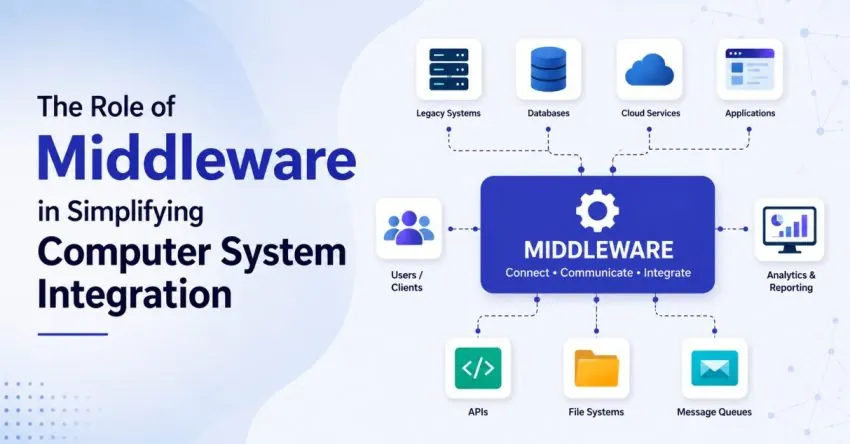
In today’s fast-paced digital environment, organizations rely on multiple applications, platforms, and databases to manage their operations. However, connecting these diverse systems can be complex and time-consuming. This is where middleware plays a crucial role. Acting as a bridge between different applications, middleware simplifies computer system integration by enabling seamless communication and data exchange.
What Is Middleware?
Middleware is software that bridges the gap between operating systems and application programs and helps with the interaction of dissimilar systems. Middleware can be thought of as a translator that ensures data produced by one system is understandable by another system. Without middleware, integration of computer systems would have been difficult.
Quick help from CNC — West Patel Nagar, Delhi
Need laptop repair or data recovery help?
CNC is at West Patel Nagar, Delhi — same-day service, free diagnosis, No Fix No Charge.
⭐ 4.9★ · 1,001 Google reviews · Since 1996 · GST invoice · Learn more →
Simplifying Communication Between Systems
A major advantage of using middleware is that it streamlines the process of communication. In most cases, computer systems in companies use varying software and architectures. The use of middleware addresses this challenge since it provides a standard platform on which systems communicate. As a result, computer system integration is improved because systems can communicate easily.
Enhancing Scalability and Flexibility
Organizations have varying demands depending on their growth. With middleware technology, an organization can continue growing while still maintaining efficiency in computer system integration. The fact that applications are separate means that changes can be made without affecting other elements in the application.
Supporting Real-Time Data Processing
Today’s businesses need data to be available in real time for decision making. The use of middleware helps in the transfer of data at an instant basis, hence always having updated information whether it is dealing with customers’ transaction data or inventory level data. The use of middleware makes computer system integration faster and more efficient.
Improving Security and Reliability
The integration of several systems poses some security risks and this makes middleware necessary. Some of the functionalities included in middleware are encryption, authentication, and access control. Such functionalities help in securing data during the transfer process in computer system integration processes. Error detection and recovery capabilities can also be handled using middleware technology.
Reducing Development Time and Costs
The process of establishing links between all systems within an organization is a costly task and can be quite cumbersome. With the use of middleware, there is no need to construct such direct connections as the software already offers reusable parts and predefined connectors. Hence, developers do not have to spend time writing new code but instead concentrate on innovation. It enables companies to integrate their computer systems more effectively and at a lower cost.
Conclusion
In conclusion, middleware proves indispensable in addressing the challenges of integrating IT systems through efficient communication, increased scalability, real-time processing, and security.
Also Read: How Data Recovery Software Handles Hard Drive Failures
Frequently Asked Questions (FAQ’s)
Classic Network and Computers — Delhi Since 1996
Need IT support for your Delhi business?
CNC provides complete IT services in Delhi NCR — laptop repair, AMC, cyber security, CCTV, cloud, data recovery, networking and UPS. 4.9★ Google rating. 960+ reviews. Free site assessment. No Fix No Charge. Trusted since 1996.
Our Services in Delhi NCR
Popular Posts
📍 O-41 West Patel Nagar · Mon–Sat 10 AM–7 PM
Need laptop repair or data recovery help?
CNC is at West Patel Nagar, Delhi — same-day service, free diagnosis, No Fix No Charge.
⭐ 4.9★ · 1,001 Google reviews · Since 1996 · GST invoice · Learn more →
IT services in Delhi — since 1996
Classic Network and Computers (CNC) is an IT services company at O-41, West Patel Nagar, New Delhi, providing computer repair, data recovery, networking, AMC, CCTV, and IT solutions to homes and businesses across Delhi NCR since 1996. Rated 4.9★ from 1,001 Google reviews. Open Mon–Sat, 10 AM–7 PM.
Prices and rates mentioned in this article are indicative estimates as of June 2026, exclusive of GST unless stated, and may change without notice due to exchange-rate movements, supply constraints and market demand. Please confirm current pricing and availability with CNC before making any decision.