
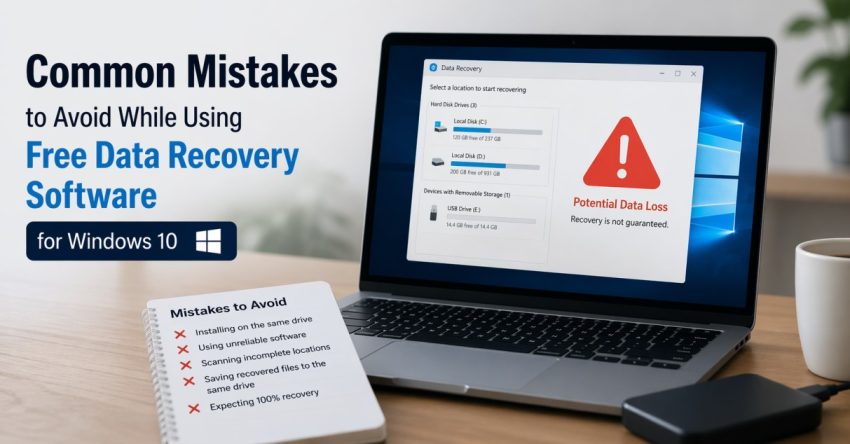
Losing important files can be stressful, and many users turn to Free Data Recovery Software for Windows 10 as a quick and cost-effective solution. While these tools can be highly useful, improper usage can reduce the chances of successful recovery or even cause permanent data loss. Understanding common mistakes can help you make the most of these tools and protect your valuable data.
Continuing to Use the Affected Drive
The use of the same drive is one of the biggest errors that people made after losing the data. As files are deleted, they are not deleted but are marked as free space. Recovery with Free Data Recovery Software for Windows 10 can overwrite the lost data and thus cannot recover it, when the drive is still in use. It is important to quit using the affected drive as soon as data has been lost.
Installing Recovery Software on the Same Drive
The other mistake is installing the recovery tool on the same drive where the data has been lost. This may corrupt the very files that you want to recover. To reduce risks always install Free Data Recovery Software for windows 10 on a different drive or on a portable version on an external storage device.
Not Scanning Thoroughly
Many users opt for quick scans instead of deep scans to save time. While quick scans are faster, they may not detect all recoverable files. Missing out on a full scan may result in unsuccessful recovery outcomes. In this case, with Free Data Recovery Software Windows 10, it is recommended to perform a deep scan particularly of very important data.
Recovering Files to the Same Location
Another essential error is saving back-up files to the same drive. This is likely to destroy other recoverable files and minimize the likelihood of retrieving more files. To use Free Data Recovery Software on Windows 10, it is safer to save recovered data on an external drive or even a separate partition.
Ignoring File Previews and Recovery Quality
Some users restore files without previews or file quality checks. This can result in corrupted or unusable files being restored. The majority of trusted recovery tools has preview features-utilize them to confirm that files are intact and then proceed with the recovery.
Relying Solely on Free Tools for Complex Cases
Although free tools are useful in simple recovery cases, they might not be capable of managing serious cases of data loss such as formatted drives and partition failures. Depending entirely on Free Data Recovery Software for Windows 10 in such cases can lead to incomplete recovery. Professional solutions may be necessary for complex issues.
Conclusion
Data recovery involves the application of data recovery tools that need to be used with care and caution. By not making some of the most frequent errors like overwriting data, inappropriate installation, and incomplete scanning, you may have a much better chance of success. Free Data Recovery Software for Windows 10 can be a great tool in your hands where appropriate, though it is important to learn how to use it, but understanding its limitations and best practices is key to protecting your data.
Also Read: DIY vs. Professional Computer Repair: When to Seek Expert Help