
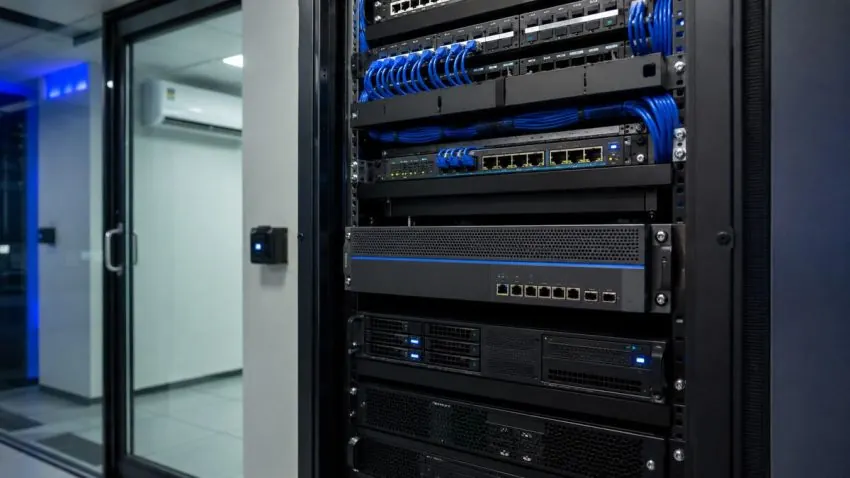
Quick answer: Network security for a Delhi office means four layers working together — a hardware firewall at the internet edge, encrypted Wi-Fi and VPN, endpoint protection on every PC, and someone actually watching the logs. For a 10–50 user office in Delhi NCR, a properly configured setup costs ₹35,000–₹1.5 lakh one-time plus ₹2,500–₹8,000/month for licences and monitoring. CNC has designed and maintained networks for USAID, UNDP, AIIMS, TCS and 100+ Delhi organisations since 1996.
Network security vs cyber security — what’s the difference?
People use the terms interchangeably, but they’re not the same thing. Network security protects the pipes: your router, firewall, switches, Wi-Fi and the traffic flowing through them. Cyber security is the umbrella — it also covers endpoints (laptops, phones), applications, cloud accounts, email, and the people using them.
Quick help from CNC — West Patel Nagar, Delhi
Need laptop repair or data recovery help?
CNC is at West Patel Nagar, Delhi — same-day service, free diagnosis, No Fix No Charge.
⭐ 4.9★ · 981 Google reviews · Since 1996 · GST invoice · Learn more →
In practice, for a Delhi SME the split looks like this:
| Layer | What it protects | Typical tool |
|---|---|---|
| Network security | Internet edge, LAN, Wi-Fi, site-to-site links | Fortinet / Cisco / Sophos firewall, managed switches, WPA3 Wi-Fi |
| Endpoint security | Each laptop, desktop, server | EDR/XDR (CrowdStrike, Sophos Intercept X, Microsoft Defender for Business) |
| Identity & email | User accounts, mailboxes | MFA, Microsoft 365 / Google Workspace security policies |
| Data | Files at rest and in transit | Encryption (BitLocker, TLS, VPN), backups |
Most breaches we’re called in to clean up in Delhi happened because one of these layers was missing entirely — usually a consumer-grade router doing the firewall’s job, or no MFA on email.
The components of a secure office network
1. Hardware firewall (not the ISP router)
The single most important purchase. An ISP-supplied router does NAT, not inspection. A next-generation firewall (NGFW) inspects traffic, blocks known-malicious destinations, enforces web filtering and terminates VPNs. For Delhi offices we deploy FortiGate 40F/60F (10–60 users), FortiGate 100F (60–250 users) or Cisco Meraki MX where cloud management matters.
2. Network segmentation (VLANs)
Guest Wi-Fi, CCTV cameras, printers, and staff PCs should be on separate VLANs. A compromised CCTV DVR on the same network as your Tally server is how ransomware spreads — we’ve seen this in Delhi manufacturing units more than once.
3. Encryption everywhere it moves
Encryption turns readable data into ciphertext that only the intended recipient can decode. Three places it must be on:
- Wi-Fi: WPA3 (or at minimum WPA2-Enterprise). WEP and open networks are a breach waiting to happen.
- Remote access: SSL-VPN or IPsec VPN for staff working from home — never port-forward RDP to the internet.
- Disks: BitLocker/FileVault on every laptop. A stolen laptop in a Delhi Metro is a data-loss incident only if the disk is unencrypted. This is also a DPDP Act 2023 expectation for personal data.
4. Access control and MFA
Least-privilege user accounts, no shared logins, MFA on email/cloud/VPN. This alone stops the majority of credential-phishing attacks.
5. Patching and monitoring
Firewall firmware, Windows updates, and router/switch firmware on a monthly cycle. Logs reviewed weekly — or fed to a managed service that alerts you.
Firewall types explained (and which one you need)
| Type | How it works | Best for | Indicative price (Delhi) |
|---|---|---|---|
| Packet-filtering | Allows/blocks by IP and port only | Built into routers; not sufficient alone | Included |
| Stateful inspection | Tracks connection state | Small offices with low risk | ₹8,000–₹20,000 |
| Next-generation (NGFW) | Deep packet inspection, IPS, app control, web filter, VPN | Any business handling client or financial data | ₹25,000–₹1.2 lakh + annual licence |
| Cloud / FWaaS | Firewall delivered from the cloud | Multi-branch, remote-heavy teams | ₹800–₹2,500/user/month |
For 95% of Delhi SMEs the answer is an entry-level NGFW with a UTM licence. We size it to your internet bandwidth and user count, not the brochure.
Top network threats we see in Delhi NCR (2026)
- Ransomware via exposed RDP — still the #1 cause of the “all our files have .lockbit extension” call.
- Phishing that harvests Microsoft 365 credentials — then forwarding rules silently exfiltrate invoices.
- Compromised IoT (CCTV DVRs, smart devices) on flat networks.
- Unpatched firewalls — FortiOS and SonicWall CVEs are actively exploited within days of disclosure.
- Insider misuse — ex-employees whose accounts were never disabled.
What does network security cost for a Delhi office?
| Office size | One-time (hardware + setup) | Monthly (licences + managed monitoring) |
|---|---|---|
| 5–10 users | ₹35,000–₹60,000 | ₹2,500–₹4,000 |
| 10–50 users | ₹60,000–₹1.5 lakh | ₹4,000–₹8,000 |
| 50–200 users | ₹1.5–₹5 lakh | ₹8,000–₹25,000 |
Prices as of August 2026, GST extra. A VAPT (vulnerability assessment & penetration test) is ₹15,000–₹75,000 depending on scope.
How CNC sets up network security in Delhi
We’re a Fortinet and Cisco partner based at O-41 West Patel Nagar, near Shadipur Metro. A typical engagement: free network audit → firewall sizing and quote → installation with VLANs, VPN and MFA → documentation → optional AMC with monthly patching and log review. Same engineers who did it come back for support — no call-centre queue.
Book a free network security audit: call +91-98101-30131, WhatsApp +91-81309-92267, or see our cyber security services and network solutions pages.
FAQs
Is a hardware firewall necessary if we already use antivirus?
Yes. Antivirus protects the device after a threat arrives; a firewall stops it reaching the device. They cover different layers.
How often should a firewall be updated?
Firmware monthly, or immediately on a critical CVE. Signature databases (IPS, antivirus, web filter) update automatically with a valid licence — an expired licence means the firewall is only doing basic filtering.
Does network security help with DPDP Act compliance?
It’s a prerequisite. The DPDP Act 2023 requires “reasonable security safeguards” for personal data; encryption, access control and breach detection are exactly that. See our DPDP compliance service.
Can CNC manage our network security remotely?
Yes — most of our AMC clients across Delhi NCR are monitored remotely with on-site visits for hardware work. See AMC services.
📍 O-41 West Patel Nagar · Mon–Sat 10 AM–7 PM
Need laptop repair or data recovery help?
CNC is at West Patel Nagar, Delhi — same-day service, free diagnosis, No Fix No Charge.
⭐ 4.9★ · 981 Google reviews · Since 1996 · GST invoice · Learn more →
Prices and rates mentioned in this article are indicative estimates as of September 2026, exclusive of GST unless stated, and may change without notice due to exchange-rate movements, supply constraints and market demand. Please confirm current pricing and availability with CNC before making any decision.